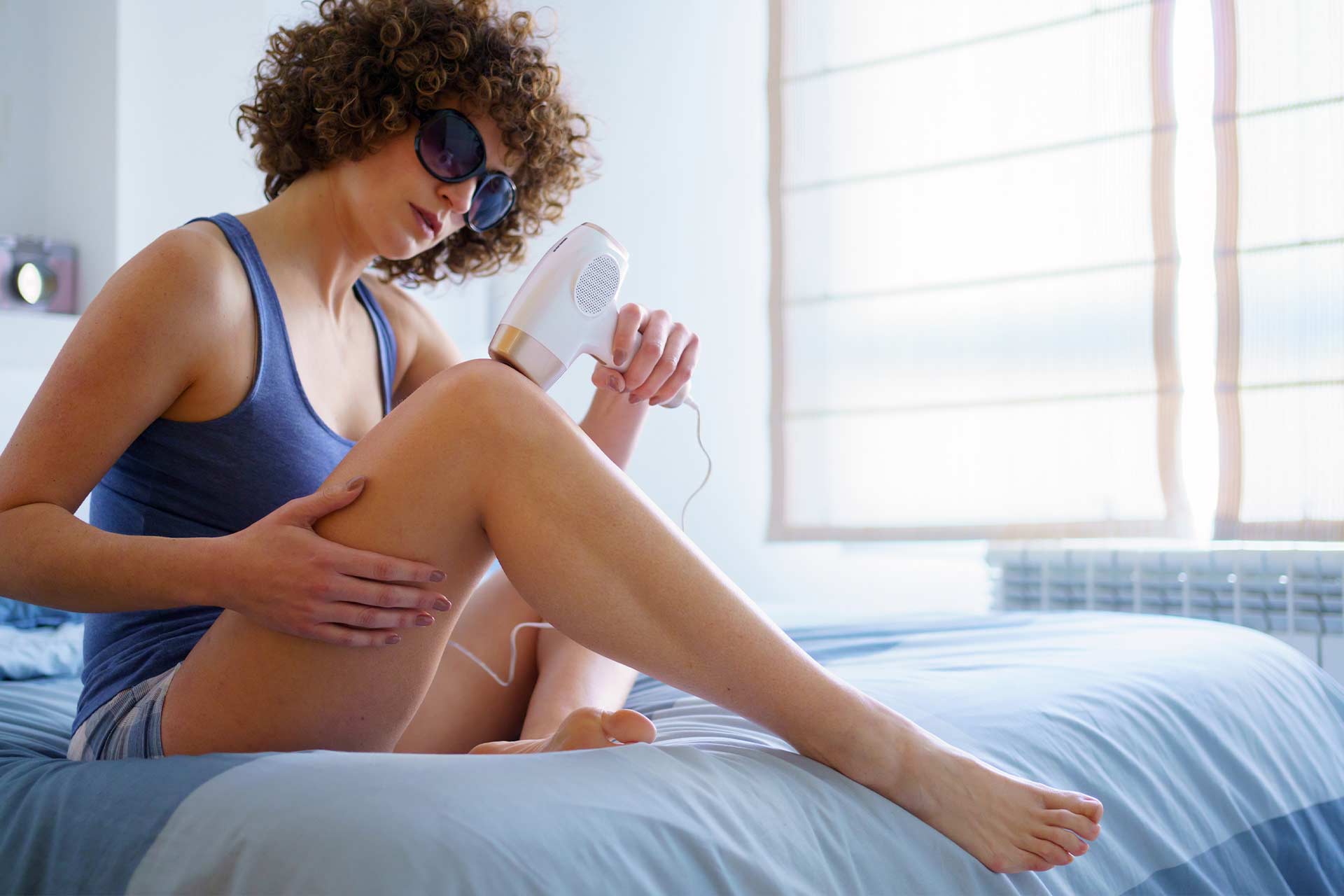
At-home laser hair removal and IPL hair removal can reduce hair for some people; they do not permanently remove it.
If you are deciding whether to buy a device for at-home use, check what it can do for your hair colour, skin tone, and treatment area. If you already bought one and feel disappointed, you did nothing wrong. You can still choose a path to permanent hair removal.
At-Home Laser Hair Removal vs Professional Laser
At-home laser and IPL devices use lower power than professional equipment to reduce the risk of injury during home use. That safety limit can mean slower hair reduction.
In a small study that compared a home IPL device with a professional laser on underarm hair, the home device reduced hair counts by about half, while the professional laser reduced them by more than 80%. Both were measured three weeks after the last session in a series of six.
Three weeks is too soon to show what lasts. Laser and IPL put many hairs into a resting state, and in our clinics we see that hair start to grow back within about six months. When a laser device is cleared for permanent hair reduction, the reduction is measured 6, 9, and 12 months after the last session. By then, both results in the study would be lower.
Home devices use either a laser or IPL. Both work the same way: the dark colour in the hair absorbs the light and turns it into heat. A laser sends one colour of light in a narrow beam. IPL (intense pulsed light) sends a broad flash that mixes many colours of light. Some home devices sold as lasers are IPL devices, including those labelled IPL laser hair removal.
Jennifer’s insight: Hair removal is a job for a trained professional. At-home devices do not operate at the same level as in-clinic standards. Save yourself the time, money, and pain of trying it at home.
Laser hair removal in a clinic reduces hair and does not remove it permanently. Some hair can return over time, even at full clinic power. We have been removing hair permanently with electrolysis since 1989.
Want more articles like this? Get notified and learn more about hair removal and beautiful skin. Subscribe to receive occasional eNews updates from Jade Clinics. Subscribe Now
Will a Device Work on Your Hair and Skin Colour?
A device needs contrast: hair that is darker than the skin around it. Your hair and skin colour affect how well it works and which side effects it can cause.
Blonde, red, grey, and white hair has little or none of that dark colour, so laser and IPL have little to heat. Electrolysis works on light hair because it does not depend on colour.
At-home laser hair removal for dark skin carries a higher risk of side effects. Darker skin holds more of the same dark colour near the surface, so it absorbs light meant for the hair. IPL hair removal side effects on darker skin include burns and lighter or darker patches of skin.
Have your hair and skin colour assessed before you buy, because the same device can reduce hair on one person and do little for another. If you already use a device and see little change, your hair or skin colour may be one of the reasons.
Can At-Home Laser or IPL Cause More Hair Growth?
The risk is low, because home devices run at much lower power than clinic equipment. At clinic power, laser and IPL can cause more hair growth instead of less. This paradoxical hair growth can make hair come back thicker or darker.
Does At-Home IPL Hurt?
Yes, at-home laser and IPL devices hurt. How much varies by person and body area. Among problems people reported with one home IPL device, skin pain came up most often, ahead of burns and redness. Turning the setting down can ease the pain, and it also lowers the power that reaches the hair.
What If You Already Bought a Device?
You can still get permanent hair removal after using a device. Electrolysis can treat the hair that remains, including hair that grew back finer or lighter.
What We See in the Clinic: Many clients tell us they bought an at-home laser or IPL device first, and some also bought an at-home electrolysis device. The devices did not work as they expected. A line we hear from clients: “I didn’t want to bother with a refund. That was my mistake.” By the time they came to us for permanent hair removal, they had spent more money than if they had started with electrolysis, and they had lost time.
Trying a device first is common, and there is nothing to be embarrassed about.
What to Expect From Electrolysis
Electrolysis treats one hair at a time with a fine probe and a small current. The current creates a barrier between the blood supply and the hair seed, so that hair does not grow back. The result depends on the skill of the Electrologist doing it, who controls the angle and depth of each insertion and the amount of current. Because it does not use light, electrolysis works on every skin tone. It also works without the risk of stimulating more growth.
Our electrolysis pain management combines numbing cream, optional local anesthesia (the same injectable used in dental work), and a cool airflow from the treatment machine. With numbing cream, most clients describe each hair as a brief sting. Each Electrologist on our team adjusts the plan to the area and to your pain tolerance.
”I began having laser on my face at 16y/o and unfortunately experienced paradoxical hypertrichosis. I saw many laser hair removal technicians and had probably close to 50 treatments over the next 10 years, even trying the Skin Care Centre at VGH, where not one technician could offer an explanation as to why I had so much hair growth or cautioned me to discontinue treatments. I ceased laser and resorted to shaving my face every day for the next 15 years. When I finally decided to try electrolysis I had lost all trust in the hair removal industry, as so many technicians were clearly just happy to make false promises to me and take my money. Trying electrolysis was a last attempt for me and a huge leap of faith, even after doing so much of my own research. When I met Aphroditi she was not just knowledgeable about electrolysis, but she was also the first technician I met who actually knew what paradoxical hypertrichosis was. Despite being very hesitant at first, I can now confidently say I am seeing amazing results. Her knowledge, experience, bedside manner, pre/post treatment care suggestions and encouragement have left me feeling the best I have felt in 20 years of dealing with the unwanted hair on my face. I can’t wait to see the results in another 8 months, and I can’t thank Aphroditi enough!
Leah L.March 2026
Next Step
If you are weighing at-home laser hair removal, or you used a device and still have hair you want removed, book a free consultation. We look at your hair colour, skin tone, and the area you want treated, and explain what permanent removal would involve. Consultations are available by video call or in person at our locations in BC and Ontario.
Common Questions About At-Home Laser Hair Removal
Does At-Home Laser Hair Removal Work Long Term?
Not permanently. Laser hair removal at home can reduce hair for some people. Keeping that reduction takes ongoing sessions, because hair can grow back over months to years. For hair that does not come back, electrolysis is the permanent option.
Is IPL Hair Removal Permanent?
No. IPL reduces hair and does not remove it permanently, whether you use a home device or have it done in a clinic. It heats the hair the same way a laser does, so some hair can grow back over time.
Do You Need Eye Protection With an At-Home Laser or IPL Device?
Follow the eye-safety instructions that come with your device. Some home devices are sold without goggles, because their makers say the light stays inside the device head. In a clinic, your eyes are covered for every laser or IPL treatment, because clinic equipment runs at much higher power. The same difference in power is also why a home device removes less hair. Light can still escape at the sides of a home device, even while it is pressed against the skin.
How Long Does Electrolysis Take to Remove Hair Permanently?
A treatment plan for one area takes about 6 to 18 months. The time depends mostly on how coarse the hair is. Coarse hair, such as beard or underarm hair, grows back every 6 to 8 weeks, so it can be cleared in about 6 months. Fine hair grows back every 12 to 14 weeks, so it can take up to 18 months. Some hairs are gone for good after each session. Face sessions are every 2 to 3 weeks, so each session treats fewer hairs and your skin has less to recover from. Body sessions are every 6 to 8 weeks. Your Electrologist gives you a realistic estimate after assessing the area.
Sources:
- PLOS ONE: Evaluating the effectiveness of laser hair reduction using a home use laser in comparison to a Diode laser – an at-home IPL device, which the study calls a “home use laser”, reduced underarm hair counts by about half, while a professional laser reduced them by more than 80%, three weeks after six sessions; the home device came without goggles because its maker says the light stays inside the device, and light still escaped at the sides of the device head during treatment
- U.S. Food and Drug Administration: 510(k) Summary K231910 – permanent hair reduction is a long-term, stable reduction in the number of hairs regrowing, measured 6, 9, and 12 months after the last treatment
- Health Canada: Cosmetic Laser Treatments – hair and skin colour affect how well laser hair reduction works and which side effects it can cause, such as burns and lighter or darker skin, and it is not as effective on blonde, red, grey, or white hair or on dark skin
- Lasers in Surgery and Medicine: Assessment of adverse events for a home-use intense pulsed light hair removal device using postmarketing surveillance – skin pain was the most commonly reported problem with a home IPL device, ahead of burns and redness
- HealthLink BC: Electrolysis for Removing Hair – electrolysis permanently removes unwanted hair when done correctly, and the result depends on the skill of the person doing it